EV Charging Time Explained: How Long Does It Take to Fully Charge an Electric Scooter?
Published by VIDA
Read Time: 2 min
Date: 24th June 26
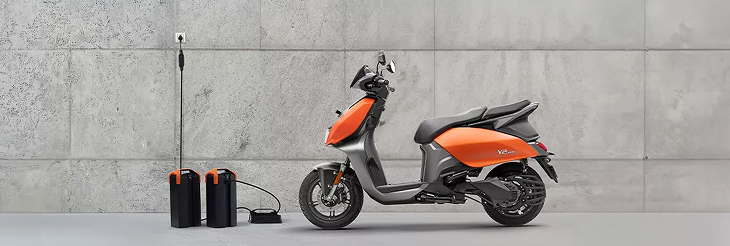
India is going electric fast. Electric two-wheeler sales crossed 12.8 lakh units in 2025, marking 11% year-on-year growth. Yet one question comes up more than any other when riders consider switching: How long does charging actually take? Understanding EV charging time is essential because it directly shapes your daily routine. Your charger type, battery size, and a few other real-world variables depend on whether you live in an apartment or an independent house.
Let's break it all down.
What is the electric scooter charging time?
Electric scooter charging time is the duration required to recharge the battery from low to full capacity. Manufacturers usually mention two charging benchmarks:
0% to 80%
0% to 100%
The first phase charges faster because lithium-ion batteries accept energy more efficiently at lower charge levels. Charging slows after 80% to protect battery health.
Two main factors determine charging speed:
Battery capacity (kWh)
Charger wattage
A larger battery stores more energy and takes longer to charge. A higher-wattage charger reduces charging duration.
VIDA EV scooters support three charging methods:
Direct vehicle charging
Removable battery charging
Fast charging network access
The removable battery setup allows charging through a standard 5A household socket, making charging convenient even in apartments and office spaces.
How long does it take to fully charge an electric scooter?
Almost 70% of electric scooters in India are charged at home, which takes approximately 3 to 6 hours with a standard home charger.
Fast charging reduces charging time significantly:
0% to 80%: around 60 minutes
0% to 100%: approximately 80 to 90 minutes
Electric scooters can be charged at:
Home
Office parking areas
Public charging stations
Fast-charging hubs
For most daily commuters, overnight charging comfortably covers routine travel requirements.
VIDA’s fast-charging network delivers approximately 0% to 80% charge in around 60 minutes under standard testing conditions. That is often enough time for a lunch break or quick stop during errands.
Electric scooter charging time vs battery capacity
Battery capacity is the biggest factor affecting charging duration. Here is a general estimate for standard home charging:
2 to 3 kWh battery: approximately 3 to 5 hours
3.5 to 4 kWh battery: approximately 5 to 7 hours
Across the VIDA lineup, battery capacities range from 2.2 kWh on the VIDA VX2 Go to 3.94 kWh on the VIDA V2 Pro.
The dual removable-battery setup on larger models offers added convenience, as both battery packs can be charged simultaneously at separate sockets. This reduces the effective waiting time compared to charging a single larger fixed battery.
| Tips and Hacks |
| Charge during off-peak hours to reduce electricity costs. Avoid charging in direct sunlight during summer. For regular use, keeping battery charge between 20% and 80% can improve long-term battery health and charging efficiency. |
Fast charging vs normal charging
Normal (home) charging uses a standard portable charger plugged into a 5A household socket. It is slower but convenient for overnight use.
Fast charging uses higher-wattage DC stations that can fill a battery in roughly a third of the time.
India's Bureau of Indian Standards (BIS) has approved a combined AC/DC charging connector standard, IS17017, specifically designed for light electric vehicles. This standardisation is helping to rapidly expand India's public charging infrastructure.
VIDA riders can access 5,600+ fast-charging stations across 415 cities. For most daily commuters in cities like Pune or Hyderabad, a quick top-up during errands is enough to keep the battery topped up through the week.
What affects electric scooter charging time?
Several factors influence how quickly your scooter charges:
Battery capacity (kWh): Larger batteries take longer at the same charger wattage.
Charger wattage: A higher-wattage charger delivers energy faster.
Ambient temperature: A 2025 peer-reviewed study found that SOC (state of charge) gain drops by up to 19% when temperatures exceed 40°C. Indian summers in cities like Delhi and Nagpur can push ambient temperatures past this threshold.
Battery state of health: Older or degraded cells accept charge more slowly.
Starting charge level: Charging from 20% to 80% is faster than pushing from 80% to 100%, because cells slow down at higher charge states.
| LEAF Consortium: The Push Towards a Unified EV Charging Ecosystem in India |
| India's EV charging landscape just got a major upgrade. Industry heavyweights Hero MotoCorp, Ather Energy, and IPEC India have jointly launched the Light Electric Vehicle Acceleration Forum (LEAF) — a neutral, industry-led consortium aimed at standardising charging infrastructure for electric two- and three-wheelers across the country. The initiative centres on the Light Electric Combined Charging System (LECCS), a BIS-approved "Type 7" connector that supports both slow AC and fast DC charging through a single, universal plug. With over 20 member organisations already on board, LEAF is a meaningful step toward eliminating charging anxiety and building a seamless, interoperable EV ecosystem at scale. |
Electric scooter charging time in India (real examples)
Here is a quick overview of fast-charging performance across the VIDA range:
| Model | Battery | Fast Charge (Full) | Certified Range* | Price (Ex-showroom) |
| VIDA V2 Pro | 3.94 kWh | ~62 min | 165 km | ₹1,20,300 |
| VIDA V2 Plus | 3.44 kWh | ~62 min | 143 km | ₹1,08,790 |
| VIDA VX2 Plus | 3.4 kWh | ~62 min | 142 km | ₹98,790 |
| VIDA VX2 Go 3.4 kWh | 3.4 kWh | ~62 min | 142 km | ₹87,790 |
| VIDA VX2 Go | 2.2 kWh | ~62 min | 92 km | ₹77,590 |
For example, VIDA electric scooters also remain highly affordable for urban travel, with running costs averaging around ₹0.17/km.
Is faster charging always better?
Not necessarily. Fast charging is ideal when you need a quick top-up between meetings or errands. But for daily use, standard overnight home charging is gentler on battery cells over the long term. Keeping your charge between 20% and 80% for regular use is a good habit that helps preserve battery health.
VIDA addresses long-term concerns with a standard 3-year/30,000 km battery warranty. For additional peace of mind, the opt-in VIDA Extended Battery plan covers up to 5 years/60,000 km, including degradation below 70% state of health, and is transferable to a new owner.
Key takeaways
Electric scooter charging time typically ranges from 3 to 7 hours at home and under 90 minutes via fast charging.
Battery capacity is the biggest determinant of charge duration.
Temperature, battery health, and starting charge level also play a role.
VIDA EV Scooters, powered by Hero MotoCorp, offer approximately 62-minute fast charges, removable batteries for flexible home charging, and a network of 5,600+ fast-charging stations across 415 cities.
If EV charging time has been the one thing holding you back, the numbers show it fits comfortably into a typical daily routine. Explore the full VIDA range to find a model that matches your commute.
FAQs
1. How long does it take to fully charge an electric scooter?
Most electric scooters take around 3 to 7 hours using standard home charging and approximately 60 to 90 minutes using fast charging.
2. Can I charge an electric scooter overnight?
Yes. Overnight home charging is one of the most convenient and cost-effective methods for everyday riders.
3. Does fast charging damage the battery?
Modern battery management systems regulate charging safely. Mixing home and fast charging is generally recommended for balanced battery health.
4. What is the average charging time for electric scooters in India?
Most electric scooters available in India today take 4 to 7 hours to charge at home. Fast-charging-capable models (about 50 are available in India) can complete the same cycle in under 2 hours.
5. Can I partially charge my electric scooter battery?
Absolutely. Lithium-ion batteries support partial charging, and maintaining a 20%–80% charge is recommended for better battery life.