Petrol at ₹100+: Is Switching to an Electric Scooter Finally Worth It?
Published by VIDA
Read Time: 1 min 30 sec
Date: 30th June 26
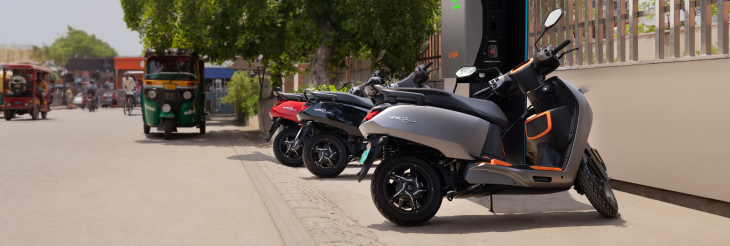
Nearly one in ten two-wheelers sold in India during May 2026 was electric. Data reports show a record 9.25% penetration for electric two-wheelers that month, up sharply from 6.11% in May 2025.
The pace of adoption is accelerating quite fast in India, but is it really worth the switch? Knowing the advantages helps you decide whether an electric scooter fits your daily routine.
Why Rising Fuel Costs Are Changing Commuting Decisions
Indian commuters are rethinking their daily ride for practical reasons. Rising fuel costs, wider EV charging networks, better vehicle technology, and stronger government support are all pushing in the same direction at the same time.
India had nearly 29,151 public EV charging stations by late 2025, with thousands more planned. These developments have pushed India's overall EV penetration to 8.5% in FY2025-26, with two-wheelers accounting for nearly 58% of all electric vehicles sold. Legacy manufacturers with established service networks have entered the segment, giving buyers the after-sales trust they expect.
What Are the Biggest Advantages of an Electric Scooter?
The main advantages of an electric scooter include zero tailpipe emissions, instant acceleration, and the flexibility of removable batteries that charge at any standard 5A home socket. Together, they change how daily ownership feels.
Lower Running Costs
Electric scooters run on household electricity instead of fuel. Charging a removable battery overnight at a standard 5A socket draws minimal power, and public fast-charging stations across hundreds of Indian cities deliver a full charge in approximately 62 minutes. You skip the fuel station entirely, charge while you sleep, and start each morning ready to ride.
Reduced Maintenance
Electric motors have significantly fewer moving parts than combustion engines. Oil changes, clutch cable adjustments, exhaust servicing, and gearbox maintenance all drop off the list entirely. Routine upkeep comes down to tyres, brakes, and periodic software checks, which means fewer trips to the service centre and shorter visits when you do go.
Convenience of Charging
Electric scooters with removable batteries offer riders three distinct charging options. You can plug the charging cable directly into the scooter at home or office, detach the battery and charge it indoors at any standard 5A household socket, or use a public fast-charging station that delivers a full charge in approximately 62 minutes. The same socket works for both the battery and the vehicle, and the standard plug fits any Indian household. You pick the method that fits your routine.
How Electric Scooter Ownership Evolves Over Time
Unlike conventional two-wheelers that depreciate as components wear out, electric scooters can improve after purchase. OTA updates refine throttle response, optimize battery management, and occasionally add features, all without a service centre visit.
Battery management systems regulate charge cycles to preserve long-term health, keeping range steady over years of use. Standard warranties of 5 years or 50,000 km cover the vehicle, while optional extended plans protect the battery for up to 5 years or 60,000 km. That coverage transfers to a new owner at resale, which helps the seller at resale and gives the buyer a warranty from day one.
How Much Can Daily Riders Actually Save?
The most immediate gain is time. Overnight charging at home removes the fuel station detour entirely. You start each morning with a full charge, ready to ride the moment you switch on.
With fewer moving parts, workshop visits drop off sharply. Oil changes, filter replacements, and exhaust inspections simply do not apply. The scooter's app flags anything that needs attention, so you go in when something actually matters.
The near-silent motor lowers rider fatigue during peak-hour commutes. Features like regenerative braking recover energy during every braking event, extending the effective range in stop-and-go Indian traffic without any extra effort.
Beyond Savings: Other Benefits of Switching to Electric
Connected features on modern electric scooters go well beyond a digital display. Turn-by-turn navigation, crash and fall detection, remote immobilisation, geofencing alerts, and OTA updates have turned these scooters into intelligent daily tools. Models like the VIDA VX2 Plus pair these features with a 4.3-inch TFT display and music control.
Electric scooters also produce zero tailpipe emissions during operation, directly reducing ground-level pollutants where pedestrians and riders breathe. A recent ICCT analysis found that meeting India's EV adoption goals could reduce road transport CO2-equivalent emissions by 50% by mid-century.
Did you know? Electric scooter motors deliver full performance the moment you switch on, regardless of weather. There is no engine warm-up period, no choke adjustment, and no waiting for fluids to circulate before riding. On cold winter mornings or during early monsoon starts, you twist the throttle and go. For most riders, this instant readiness after switching to electric scooter significantly enhances how they feel about their morning commute. |
Who Benefits Most from an Electric Scooter?
Daily office commuters covering 10–30 km, professionals who value connected technology, and environmentally conscious riders in Tier 1 and Tier 2 Indian cities gain the most from electric scooter ownership. If your commute involves predictable distances, urban traffic, and access to a standard home socket, an electric scooter fits your routine with very little adjustment.
Certified ranges of 90–165 km per charge comfortably cover a round trip with a margin. Topping up the battery at any 5A socket overnight keeps the scooter ready each morning.
The advantages extend to Tier 2 cities where public fast-charging is less dense. Because removable batteries charge on any household socket, you are not reliant on station coverage. Models like the VIDA VX2 Go are designed for exactly this profile, delivering a certified 90 km range on its standard battery, with a 3.4 kWh variant that extends it to 142 km.
Conclusion: Is Now the Right Time to Switch?
The electric scooter segment in India has advanced quite rapidly. Penetration is climbing month on month, charging infrastructure is expanding, and the riding experience has matured for everyday use.
If you commute 10–30 km daily and have access to a standard household socket, the practical case for switching is stronger now than it has ever been. You get a vehicle that improves through software updates rather than depreciating through mechanical wear. The advantages are real, and they compound over time.
FAQs
1. What are the advantages of electric scooters?
Electric scooters offer zero tailpipe emissions, instant acceleration from a standstill, near-silent operation, and the convenience of charging at home on a standard household socket. They also require far less routine maintenance because the motor has fewer moving parts. Connected features like turn-by-turn navigation, crash alerts, and over-the-air software updates add a layer of daily practicality that conventional two-wheelers do not offer.
2. Are electric scooters cheaper than petrol scooters?
The upfront purchase price of an electric scooter can be comparable to or slightly higher than a petrol equivalent, depending on the model. Over time, however, the running and maintenance costs tend to be significantly lower. Electricity is cheaper per kilometre than fuel, and the reduced need for servicing (fewer moving parts, fewer consumables) brings down the long-term cost of ownership noticeably.
3. How much money can I save with an electric scooter?
The exact savings depend on your daily distance, riding habits, and local electricity rates, but most daily commuters notice a meaningful drop in their monthly running expenses after switching. Fewer workshop visits, lower energy costs per kilometre, and the elimination of oil and filter changes all contribute. Over a few years of ownership, the cumulative difference tends to be substantial.
4. Is an electric scooter worth buying in India?
For most urban commuters covering 10–30 km daily, yes. Charging infrastructure across Indian cities has expanded rapidly, certified ranges now comfortably exceed typical daily commute distances, and removable batteries let you charge at any standard 5A home socket. Backed by established manufacturers with wide service networks, electric scooters in India have matured enough to be a practical everyday choice rather than an early-adopter experiment.