Lightweight Electric Scooters in India: Why Weight Matters for Daily Riders
Published by VIDA
Read Time: 1 min 30 sec
Date: 25th September 26
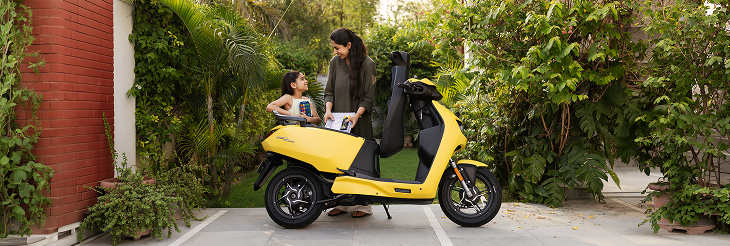
| Summary: A lighter, well-balanced electric scooter is easier to park, pull off the stand, and manoeuvre through Indian city traffic. Here's how kerb weight really shapes your daily ride. |
India's EV market has grown 46 times over the past decade, with electric two-wheelers leading at over 12.8 lakh units sold in FY2025 alone. The pace has only accelerated into 2026, with lakhs of first-time buyers entering the segment every quarter.
Kerb weight is one of the first specs a buyer checks before a test ride, and for good reason. If you ride through Pune's narrow lanes, reverse into a Bengaluru apartment basement, or pull a scooter off the centre stand before your morning commute, weight shapes your experience as much as range or top speed.
Here's how kerb weight, weight distribution, and design determine whether a lightweight electric scooter feels right for daily use.
Why Scooter Weight Matters
A lighter, well-balanced scooter is easier to manoeuvre in slow traffic, park in tight spots, and pull off the centre stand, especially for shorter riders and daily city commuters. For anyone riding 10–30 km a day through Indian urban conditions, the difference between a 106 kg and a 125 kg scooter shows up at every red light, every U-turn, and every basement ramp.
Weight affects three things directly. Low-speed stability improves when the mass sits lower and closer to the rider. Parking confidence grows when you can lean the scooter and walk it into a gap without straining. And daily fatigue drops when pulling the scooter off its stand each morning doesn't feel like a workout. Riders who have never owned a two-wheeler before, or those returning to riding after years, feel the difference most sharply.
Kerb Weight vs Handling: How the Feel Actually Works
Kerb weight is the total mass of a scooter with all fluids and batteries but without rider or cargo. For electric scooters in India, kerb weight typically falls between 100 and 130 kg. A single number on a spec sheet, though, doesn't capture how the scooter will feel in your hands.
Three factors shape real-world handling.
- Weight distribution and centre of gravity: A scooter with its battery placed low in the chassis feels more planted and balanced at walking speeds than one with top-heavy mass, even at identical kerb weight. Floor-mounted battery packs, common in modern electric scooters, keep the centre of gravity closer to the road.
- Seat height: A 777 mm seat height (the specification across VIDA's current range) lets most riders place both feet flat on the ground at a stop, adding confidence in dense traffic. Flat-footed reach matters more than raw weight when you're balancing at a signal.
- Wheel size and tyre width: 12-inch alloy wheels offer a good balance between stability and agility for city riding. Larger wheels track better over speed breakers and uneven patches, reducing the rider's effort to keep the scooter upright.
Connected smart features like reverse mode (available across the current lineup at up to 3 km/h) also help riders handle tight spaces without physically pushing the scooter backwards.
| Did you know? A scooter's centre of gravity affects low-speed balance more than its kerb weight. Two scooters weighing 115 kg can feel very different at a traffic signal if one carries its battery pack low and the other positions mass near the seat. Floor-mounted removable batteries, the configuration VIDA uses across its range, keep weight low and improve rider confidence. |
Where a Manageable Weight Helps Most
A manageable kerb weight pays off in five everyday situations urban commuters encounter repeatedly.
- Stop-go traffic: At each red light, the rider plants a foot and holds the scooter upright. A well-balanced, lighter scooter reduces the physical effort over a 30-minute commute..
- Tight parking: Apartment complexes, office basements, and roadside slots in Indian cities rarely offer generous space. Walking a sub-115 kg scooter into a narrow slot is noticeably easier.
- Ramps and basements: Inclined surfaces demand more effort from the rider. A lighter scooter paired with good gradeability (VIDA's VX2 Go models handle 15.0° inclines) makes basement parking practical, not stressful.
- New and returning riders: First-time riders or those returning after a break build confidence faster on a scooter they can physically manage at slow speeds. Weight anxiety disappears once they've walked the scooter a few metres.
- Shorter riders: When your feet barely reach the ground, every kilogramme you don't have to steady at a stop counts. A 777 mm seat height and a kerb weight under 115 kg give shorter riders a comfortable margin.
These situations are where the search for a lightweight electric scooter starts, and where the right choice makes a visible difference.
Weight vs Range and Features: Finding the Balance
A bigger battery adds both range and weight. Every electric scooter buyer in India must weigh the trade-off against their daily commute distance.
A single 2.2 kWh battery pack, for instance, keeps kerb weight at 106 kg while delivering 93 km of IDC range and up to 75 km in real-world conditions. For a rider whose daily round trip is 20–30 km, the range comfortably covers the commute with room to spare. A dual-battery 3.4 kWh configuration pushes IDC range to 146 km but adds weight, bringing kerb figures closer to 115 kg.
The right balance depends on your commute. Riders with shorter daily distances (under 30 km) benefit more from the lower weight and easier handling of a single-battery scooter. Those covering 40–50 km daily, or riders who want the flexibility of fewer charging stops, may prefer the extra range even at a slightly higher kerb weight.
Battery capacity also affects daily commute mileage in Eco mode, where energy-efficient riding can stretch range further without adding a single gramme to the scooter's weight.
Easy-to-Manage VIDA Scooters
VIDA, powered by Hero MotoCorp, designed the VX2 family around the daily-rider brief, with kerb weights between 106 and 120 kg, a consistent 777 mm seat height, and removable batteries keeping the centre of gravity low. Every model shares 12-inch alloy wheels, 155 mm ground clearance, and a floor-mounted battery layout for stable, planted handling.
Here's how the current range stacks up by kerb weight and daily-range suitability.
| Model | Kerb Weight | IDC Range | Real-World Range (Eco) | Battery | Ride Modes |
|---|---|---|---|---|---|
| VIDA VX2 Go 2.2 kWh | 106 kg | 93 km | 75 km | 1 × 2.2 kWh | Eco, Ride |
| VIDA VX2 Go 3.4 kWh | 115 kg | 146 km | 110 km | 2 × 1.7 kWh | Eco, Ride |
| VIDA VX2 Plus 3.4 kWh | 115 kg | 146 km | 110 km | 2 × 1.72 kWh | Eco, Ride, Sport |
| VIDA VX2 Plus 4.4 kWh | 120 kg | 187 km | 140 km | 2 × 2.2 kWh | Eco, Ride, Sport |
All VX2 models come with a standard 5-year/50,000 km vehicle warranty and a 3-year/30,000 km battery warranty. For buyers who want lower upfront costs, BaaS (Battery as a Service) is available across the VX2 family through partner financiers at VIDA dealerships.
The only reliable way to judge whether a scooter's weight works for you is to ride it. You can book a test ride and feel the balance firsthand, or compare VIDA models side by side.
Conclusion
The number on a spec sheet matters, but it's only part of making a lightweight electric scooter genuinely easy to live with. A well-placed battery, a reachable seat height, and the right wheel size do more for daily confidence than shaving a few kilogrammes off the frame.
For urban Indian riders who commute through congested roads, park in cramped spaces, and want a scooter they can manage without a second thought, the 106–120 kg range covers most needs. The real differentiator is how the scooter feels in your hands, at your height, on your route.
FAQs