Growth of EV Charging Infrastructure in India: What Electric Scooter Owners Need to Know
Published by VIDA
Read Time: 1 min 30 sec
Date: 18th August 26
| Summary |
| India's EV charging infrastructure has grown from 5,151 stations in 2022 to over 29,000 in 2025. Here is what electric scooter owners need to know about charging options, costs, and future expansion. |
India now has more than 29,000 public EV charging stations across the country. That number has grown nearly sixfold since 2022. For electric scooter owners, this rapid build-out of EV charging infrastructure directly shapes daily ownership experience, from how you plan your commute to what you spend each month.
With more than 1 million electric two-wheelers sold within the first 7 months of 2026 itself, two-wheeler charging solutions are no longer a niche concern. Whether you are considering your first electric scooter or already own one, understanding the charging network is essential.
The current state of EV charging infrastructure: numbers that matter
The growth trajectory tells a clear story. India had 5,151 public charging stations at the end of 2022, which doubled to 11,903 by December 2023 and doubled again to 25,202 by December 2024. Of the current nearly 29,000 stations, 8,805 are fast chargers and 20,346 are slow chargers.
However, distribution is uneven. Karnataka, Maharashtra, Uttar Pradesh, Delhi, and Tamil Nadu account for about 60% of all stations. If you live in Bengaluru or Mumbai, you will find public chargers within a few kilometres. In smaller cities, home charging becomes your primary option.
What is EV charging infrastructure? A scooter owner's guide
EV charging infrastructure refers to the entire ecosystem that keeps electric vehicles running: home charging setups, public charging stations, fast-charging networks, and the apps and payment systems that connect them. For electric scooter owners specifically, the infrastructure equation is simpler than for car owners, because scooter batteries are smaller and many models support removable batteries that can be charged at a regular household socket.
The key distinction worth understanding: slow chargers (AC) take longer but cost less per kWh, while fast chargers (DC) provide quick top-ups at a higher rate. Most scooter owners rely on home charging for daily needs and use public stations only for longer trips or emergencies.
Types of charging solutions for electric scooters in India
Home charging: the primary solution for most scooter owners
Home charging is where most electric scooter owners do the bulk of their charging. Domestic electricity tariffs across India range from ₹3 to ₹10 per unit, which means a full scooter charge typically costs ₹20 to ₹50. The Ministry of Power has classified EV charging station setup as an unlicensed activity, so housing societies and private individuals can install chargers without regulatory hurdles.
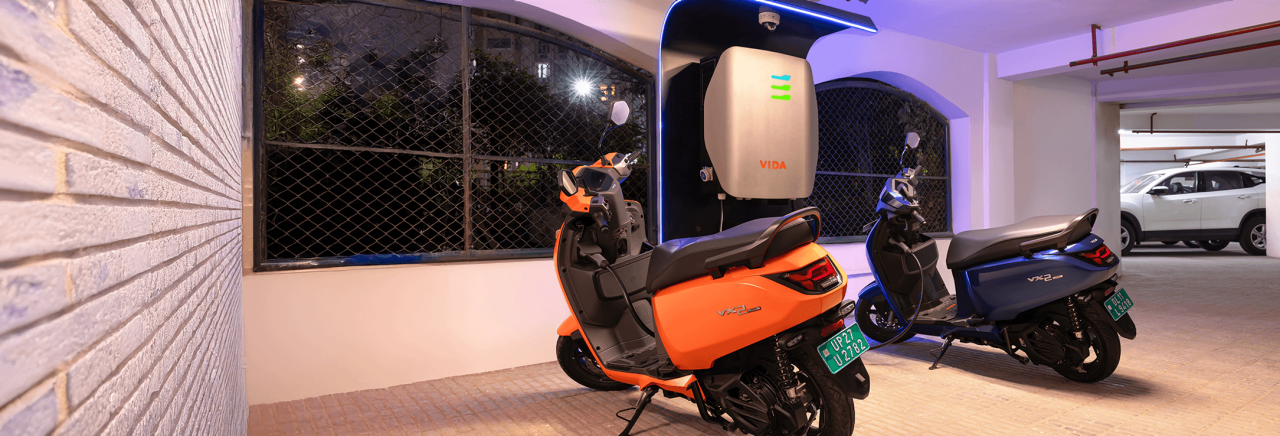
Scooters with removable batteries add another layer of convenience. VIDA EVooters, for instance, let you detach the battery, carry it to any standard 5A socket, and charge it indoors. The shared charging socket works for both vehicle-attached and detached battery charging, with no separate adaptor needed.
Public charging stations: when you need them
Public EV charging stations in India typically charge ₹8 to ₹15 per kWh for AC slow chargers and ₹15 to ₹25 per kWh for DC fast chargers. Urban areas like Delhi, Bengaluru, and Mumbai have the highest density.
VIDA's own fast-charging network spans 5,900+ stations, delivering a full charge in approximately 62 minutes. Combined with home charging and removable battery charging, VIDA owners have three distinct charging methods.
How India's charging network is expanding: what you need to know
The PM E-DRIVE Scheme allocates ₹2,000 crore specifically for public charging infrastructure, targeting 72,300 chargers nationwide. In May 2026, the Ministry of Heavy Industries approved proposals worth ₹503.86 crore for 4,874 additional chargers.
A significant upcoming development is the Unified Bharat e-Charge (UBC) app, a pan-India platform that will let EV users locate chargers and pay across multiple operator networks through a single interface.
On the interoperability front, Hero MotoCorp is a founding member of LEAF (Light Electric-Vehicle Acceleration Forum), an industry consortium formed with Ather Energy and IPEC India to standardise and improve the charging ecosystem for two- and three-wheelers. LEAF is also driving adoption of LECCS (Light Electric Combined Charging System), a BIS-approved connector standard aimed at making charging networks interoperable across operators.
Urban vs. rural: the infrastructure divide electric scooter owners face
The tier-wise breakdown reveals an interesting pattern. By April 2025, about 9,702 chargers were in Tier 1 cities, 4,625 in Tier 2 cities, and 12,040 in Tier 3 and smaller towns. The numbers for smaller towns look encouraging, but consider that they are spread across far more locations.
Bihar has grown nearly tenfold over the past five years in terms of EV sales, with annual registrations crossing 1.23 lakh in calendar year 2025, but had only 521 operational charging stations. This mismatch highlights why home charging for electric scooters matters. Scooters with removable batteries, like VIDA EVooters, let owners in infrastructure-thin cities charge at home via standard 5A sockets without waiting for public networks to catch up.
What does it cost? Understanding charging infrastructure economics
At home, a full electric scooter charge costs ₹20 to ₹50 depending on your state tariff. Public DC fast charging runs approximately ₹15 to ₹25 per kWh, though rates vary by operator and location.
Monthly charging costs: what VIDA owners actually spend
VIDA EVooters run at approximately ₹0.17/km. For a typical daily commute of 30 km, that works out to about ₹153 per month. A full home charge for the VIDA V2 Pro (3.94 kWh battery) costs approximately ₹28 at an average tariff of ₹7/unit, delivering up to 165 km IDC certified range*. The VIDA VX2 Plus 4.4 kWh costs approximately ₹31 per full charge for up to 187 km IDC certified range.
For VX2 owners who prefer flexible ownership, BaaS (Battery as a Service) reduces the upfront cost of the electric scooter by a considerable margin.
Finding charging stations: apps, networks, and real-world accessibility
Currently, BEE's EV Yatra portal (evyatra.beeindia.gov.in) lists public charging stations across India. The upcoming Unified Bharat e-Charge (UBC) app will unify all CPO networks into one platform. VIDA owners can also use the VIDA Edge app for navigation, station locators, and smart alerts.
Government initiatives driving infrastructure growth
The policy push behind India's EV infrastructure growth is substantial:
PM E-DRIVE Scheme: ₹10,000 crore total allocation, with ₹2,000 crore for charging infrastructure and up to 80% subsidy on upstream electrical infrastructure for operators
Licensing clarity: The Ministry of Power has clarified that EV charging does not require any licence
Scale needed: A CII report estimates India will need at least 1.32 million charging stations by 2030, requiring over 4,00,000 installations annually
What's coming next: future of EV charging infrastructure for scooter owners
Smart charging and grid integration
The Ministry of Power's 2024 guidelines outline standards for connected, interoperable charging networks, including battery swapping infrastructure. As the EV penetration rate heads towards 9.5% to 10% in FY2026-27, grid integration and smart charging protocols will become critical.
The road to 2027: what infrastructure will look like
To reach a 30% EV market share by 2030, India needs an estimated 1.32 million public charging stations. The momentum is real: 1.4 million electric two-wheelers were registered in FY2026 alone, a 22% jump from the year before.
Common charging infrastructure challenges (and how they're being solved)
The gap between installed and operational chargers is a real issue. The government is working with state governments and industry to ensure grid readiness, standardisation, and digital integration.
For scooter owners, the practical workaround is straightforward: do not depend on a single charging method. VIDA EVooters address this with three options (direct charge, removable battery at any 5A socket, and 5,900+ fast-charging stations), plus IP67-rated batteries and IP68-rated motors for reliability across conditions.
Making the most of today's infrastructure: practical tips for VIDA scooter owners
Charge overnight at home: Most daily commutes fall well within range. The VIDA VX2 Plus 4.4 kWh delivers up to 187 km IDC certified range, enough for multi-day commuting on a single charge.
Use Eco mode and ReGen braking: Regenerative braking (activated via the two-way throttle) recovers energy during deceleration, extending range and reducing charging frequency.
Plan longer trips around fast-charging stations: VIDA's 5,900+ fast-charging stations and 770+ service outlets provide backup for trips beyond your usual range.
Trust the warranty: A 5-year/50,000 km vehicle warranty and 3-year/30,000 km standard battery warranty come included. An optional Extended Battery Warranty plan extends battery coverage to 5 years/60,000 km.
Conclusion
India's EV charging infrastructure is growing rapidly, and for electric scooter owners, the combination of affordable home charging and an expanding public network makes daily ownership increasingly practical. The infrastructure is not perfect yet, but it is improving quarter by quarter. If you are evaluating your options, explore VIDA scooters to see how removable batteries and a dedicated fast-charging network fit into your commute.
FAQs
1. How many EV charging stations are currently available in India?
India has 29,277 public EV charging stations as per the Ministry of Power, operated by 83 Charge Point Operators. Of these, 8,805 are fast chargers and 20,346 are slow chargers. The network has grown nearly sixfold since 2022, though coverage remains concentrated in five states that account for about 60% of all stations.
2. How much does it cost to charge an electric scooter at public charging stations in India?
Public EV charging stations typically charge ₹8 to ₹15 per kWh for AC slow chargers and ₹15 to ₹25 per kWh for DC fast chargers. Rates are set by individual Charge Point Operators and include electricity tariff, service charge, and GST. Home charging remains the most affordable option, with a full scooter charge costing approximately ₹30 to ₹50 at domestic tariffs.
3. Can I charge my VIDA electric scooter at home?
Yes. All VIDA EVooters feature removable Li-ion batteries that you can detach and charge at any standard 5A household socket. You can also charge the scooter directly using the same shared charging socket, with no separate adaptor needed. Home charging is the most cost-effective method, costing approximately ₹28 to ₹31 per full charge depending on your model and local electricity tariff.
4. What is battery swapping and is it available for electric scooters in India?
Battery swapping lets you exchange a depleted battery for a fully charged one at a station, avoiding wait times. The Ministry of Power issued guidelines for battery swapping and charging stations in January 2025. VIDA offers BaaS (Battery as a Service) for VX2 models, where you pay for the chassis separately and a per-km battery usage cost.
5. How long does it take to charge an electric scooter at a public charging station?
Charging times vary by charger type and battery size. At VIDA's fast-charging stations, VIDA EVooters reach full charge in approximately 62 minutes and 0 to 80% in about 65 minutes. Slow AC chargers at public stations take longer. Home charging overnight is the most common approach for daily use, since the scooter charges while you sleep.
6. Will there be enough EV charging infrastructure for the growing number of electric scooters in India?
A CII report estimates India needs at least 1.32 million charging stations by 2030, requiring over 4,00,000 installations annually. The PM E-DRIVE scheme targets approximately 72,000 new public charging stations. For scooter owners, home charging at standard sockets reduces dependence on public infrastructure, making the gap less critical than for car owners.
7. What apps can I use to find EV charging stations near me?
BEE's EV Yatra portal (evyatra.beeindia.gov.in) lists public charging stations across India. The upcoming Unified Bharat e-Charge (UBC) app will unify all CPO networks into a single discovery and payment platform. VIDA owners can use the VIDA Edge app for station navigation, ride data, and smart alerts including geo-fencing.
8. Are electric scooters practical in Tier 2 and Tier 3 cities where charging infrastructure is limited?
Yes, particularly if the scooter supports home charging. By April 2025, about 4,625 chargers were in Tier 2 cities and 12,040 in Tier 3 and smaller towns. VIDA's removable batteries charge at any standard 5A socket, making ownership practical regardless of public infrastructure density. VIDA's 770+ outlets extend service reach into smaller cities.