Electric Scooter Down Payment Guide: Affordable Financing Options for Your VIDA
Published by VIDA
Read Time: 1 min 30 sec
Date: 19th August 26
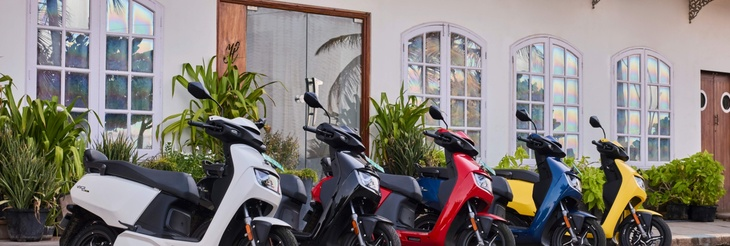
| Summary: Your electric scooter down payment decides how much you borrow, what your EMI looks like, and how the total ownership cost adds up. This guide covers every financing angle available to Indian EV buyers, including VIDA-specific plans. |
The electric scooter financing market is expected to grow by 27.7% over the next few years. Buying an electric scooter is one of the smarter financial decisions an urban Indian commuter can make today.
Your electric scooter down payment is one of the biggest factors that affects your loan terms. A higher upfront amount shrinks your EMI and total interest. A lower one preserves cash today but costs more over the full tenure.
What Is Down Payment on an Electric Scooter?
An electric scooter down payment is the amount you pay from your own funds before the loan is disbursed. The remaining financed amount becomes the principal. A larger contribution generally lowers the principal and EMI, while a smaller contribution keeps more cash with you at purchase but increases the amount on which interest is calculated.
For example, on a ₹1,30,000 financed purchase amount, a ₹10,000 down payment leaves a ₹1,20,000 loan. Some lenders also offer financing of up to 100% of the on-road price for eligible borrowers.
VIDA Electric Scooter Down Payment Options: ₹0 to ₹10,000 Compared
VIDA, powered by Hero MotoCorp, offers its EVooter lineup through authorised dealerships, where financing is facilitated by partner lenders and NBFCs. The down payment you choose shapes your monthly commitment and total repayment.
Here’s the principal for an example ₹1,30,000 amount:
| Down Payment | Loan Principal |
| ₹0 | ₹1,30,000 |
| ₹5,000 | ₹1,25,000 |
| ₹10,000 | ₹1,20,000 |
The VIDA VX2 family now spans five variants, including the recently launched VIDA VX2 Plus 4.4 kWh (190 km certified range) and the VIDA VX2 Go RQ. For VX2 buyers, VIDA also offers BaaS (Battery as a Service), which separates the battery cost from the chassis price, effectively lowering the upfront amount you need to finance.
How Down Payment Affects Your Electric Scooter EMI
Your EMI is a function of three variables, including the loan principal (which your down payment reduces), the interest rate, and the loan tenure. A higher down payment reduces the principal, producing a proportionally lower EMI at the same rate and tenure.
For instance, paying ₹10,000 upfront instead of ₹0 reduces your EMI by roughly ₹323 per month and saves over ₹1,600 in total interest. The effect grows more at higher rates or longer tenures, so even a modest increase in down payment can save thousands off total repayment.
Electric Scooter Loan Interest Rates in India (2026)
Interest rates for electric two-wheeler loans in India typically range from 8% to 16% per annum, depending on the lender, the borrower's credit profile, and the loan tenure.
| Lender Type | Indicative Rate Range | Typical Tenure |
| Banks (PSU and private) | 8–12% p.a. | 12–48 months |
| NBFCs | 10–16% p.a. | 12–60 months |
| Dealer-backed / manufacturer-partnered | 9–14% p.a. | 12–48 months |
Some lenders offer preferential rates for EVs under green financing mandates. Always compare the flat rate quoted by dealers with the reducing-balance rate from banks, as a 7% flat rate can translate to an effective rate above 12%.
EMI Calculator: Find Your Electric Scooter Monthly Payment
Most bank websites, NBFC portals, and dealership tools include built-in EMI calculators. VIDA's own savings calculator helps you estimate ownership costs for specific models. To use any calculator effectively, keep three numbers ready: the on-road price minus your chosen down payment, the annual interest rate divided by 12, and the tenure in months.
| Did you know? Zero down payment does not always equal zero cash at delivery. A lender may finance the full eligible on-road amount while processing fees, optional accessories, or other charges remain payable separately. Ask for a written break-up showing the financed amount, upfront payment, processing fee, interest rate, tenure, and total repayment. That makes similar-looking electric scooter payment plans much easier to compare. |
Complete Documentation Required for Electric Scooter Loan
Keep these documents ready before your dealership visit to speed up the approval process.
Identity proof: Aadhaar card, PAN card, voter ID, or passport.
Address proof: Aadhaar card, utility bill (not older than three months), or rental agreement.
Income proof (salaried): Latest three months' salary slips and Form 16 or current-year ITR.
Income proof (self-employed): Last two years' ITR filings, profit and loss statement, and balance sheet.
Bank statements: Last three to six months from your primary salary or business account.
Vehicle quotation: Proforma invoice from the authorised dealership specifying the model and on-road price.
Self-employed applicants may also need GST registration or proof of business vintage.
Step-by-Step: How to Apply for VIDA Electric Scooter Financing
Financing a VIDA EVooter follows a dealer-assisted process. Here is what the journey looks like.
Step 1: Choose your model. Browse the lineup at VIDA or visit a dealership. Options range from the VIDA V2 Pro to the expanded VX2 family, now including the VX2 Plus 4.4 kWh and VX2 Go RQ.
Step 2: Get a proforma invoice. The dealership generates an on-road price quotation for your chosen model and city.
Step 3: Select your financing option. VIDA dealerships work with partner lenders. For VX2 models, you can also explore VIDA BaaS, which finances the battery separately and reduces the chassis cost.
Step 4: Submit documents and receive approval. Lenders complete verification digitally within 24–72 hours. You pay your down payment, complete registration, and ride home.
The entire process typically takes three to seven working days.
Down Payment vs. No Down Payment: Total Cost Comparison
Zero-down-payment schemes remove the upfront cash barrier, but they come with trade-offs worth understanding.
| Factor | Zero Down Payment | ₹10,000 Down Payment |
| Upfront cost | ₹0 | ₹10,000 |
| Loan principal (on ₹1,00,000) | ₹1,00,000 | ₹90,000 |
| Monthly EMI (36 months, 10%) | ~₹3,227 | ~₹2,904 |
| Total interest paid | ~₹16,172 | ~₹14,554 |
| Total cost of ownership | ~₹1,16,172 | ~₹1,04,554 |
The ₹10,000 down payment saves roughly ₹1,618 in interest and lowers the monthly EMI by about ₹323. Zero-down-payment loans may also carry slightly higher rates, as lenders view them as higher-risk. If a subsidy covers the gap or preserving your emergency fund matters more right now, the higher total cost may still be a reasonable trade-off.
Credit Score Impact on Electric Scooter Down Payment and Interest Rates
Your CIBIL score plays a significant role in both the down payment your lender requires and the interest rate you receive.
| CIBIL Score Range | Likely Impact |
| 750 and above | Lowest interest rates, zero or minimal down payment options, fastest approval |
| 700–749 | Competitive rates, standard down payment (10–15%), smooth approval |
| 650–699 | Higher rates, 15–20% down payment likely required |
| Below 650 | Limited lender options, 20–30% down payment, higher rates, or co-applicant required |
If your score is below 700, paying a higher down payment voluntarily reduces the lender's risk exposure and can help you negotiate a more favourable rate. A few months of disciplined repayment on existing credit lines before applying can also move your score meaningfully.
Government Subsidies and Their Impact on Down Payment
Central and state government subsidies can reduce the effective on-road price of an electric two-wheeler, which directly lowers the amount you need to finance or pay as a down payment.
India's PM E-DRIVE scheme (which succeeded FAME-II) offers demand incentives for qualifying EVs, with amounts linked to battery capacity and revised periodically. States like Maharashtra, Gujarat, Delhi, Rajasthan, Tamil Nadu, and Karnataka have historically offered additional purchase subsidies, road tax exemptions, or registration fee waivers.
If a ₹10,000 subsidy applies to your purchase, the on-road price drops and your required down payment drops proportionally.
First-Time Buyer's Guide to Electric Scooter Financing
A first-time buyer should compare finance plans by monthly affordability and total repayment rather than the smallest advertised down payment. Start with an EMI you can manage comfortably, then choose the down payment and tenure that fit without using money set aside for routine expenses.
Keep five checks on your quotation:
Exact variant: Confirm the model, including the new VIDA VX2 Plus 4.4 kWh or VIDA VX2 Go RQ where relevant.
Financed amount: Check which on-road components the lender is covering.
Total repayment: Add interest and processing charges.
Subsidy status: Verify eligibility on the registration date.
Cash reserve: Avoid using all available savings for the down payment.
You can confirm the current VIDA VX2 Go configuration before comparing lender quotations.
Conclusion
Choosing an electric scooter financing plan is about matching your upfront payment, monthly outgo, and total interest to a structure your budget can handle comfortably. The right electric scooter down payment balances upfront cash with a manageable EMI and sensible total interest.
Zero down can suit an eligible buyer who wants to preserve cash, while a modest contribution can reduce the principal without placing too much pressure on savings.
FAQs
1. What is the minimum down payment for VIDA electric scooters?
The minimum down payment depends on the financing partner and the specific VIDA model you choose. Most partner lenders require 10–15% of the on-road price as a minimum. During select promotional periods, zero-down-payment schemes may also be available. Check with your nearest VIDA dealership for current offers applicable to your city.
2. How much EMI will I pay for a ₹1,30,000 electric scooter?
On a ₹1,30,000 electric scooter with a 10% down payment (₹13,000), a 36-month loan at 10% annual interest would result in an EMI of approximately ₹3,775. Increasing the down payment to ₹20,000 brings the EMI closer to ₹3,549. These are indicative figures; your actual EMI will depend on the lender's specific rate and tenure.
3. Which documents are required for electric scooter loan approval?
Standard documents include Aadhaar card, PAN card, address proof, income proof (salary slips for salaried applicants or ITR for self-employed), bank statements for the last three to six months, passport-size photographs, and the proforma invoice from the dealership. Self-employed applicants may also need GST registration or proof of business vintage.
4. Does a higher down payment reduce my interest rate?
A higher down payment reduces the loan principal and the lender's risk exposure, which can help you qualify for a lower interest rate. The effect is most noticeable when the higher down payment pushes your loan-to-value ratio below a threshold the lender considers low-risk, typically below 80–85% of the on-road price.
5. What credit score do I need for electric scooter financing?
Most lenders prefer a CIBIL score of 650 or above for electric two-wheeler loans. A score of 750 and above typically qualifies you for the most competitive interest rates and flexible down payment terms. Scores below 650 may still receive approval through NBFCs, but with higher rates and larger down payment requirements.
6. Can I get a loan without a credit history?
Yes. Several NBFCs and fintech lenders now offer EV-specific loan products for applicants with no prior credit history. These lenders may use alternative data points such as UPI transaction history, rent payment records, or employment stability for underwriting. Expect a slightly higher interest rate or a mandatory co-applicant requirement in some cases.
7. How long does VIDA financing approval take?
VIDA's partner financiers typically process loan applications within 24 to 72 hours after document submission, assuming all paperwork is complete and verification checks clear without issues. End-to-end, from application to vehicle delivery, the process usually takes three to seven working days. Digital document submission and e-KYC can speed things up further.