Best Family Electric Scooter in India: Complete 2026 Buying Guide
Published by VIDA
Read Time: 1 min 30 sec
Date: 19th August 26
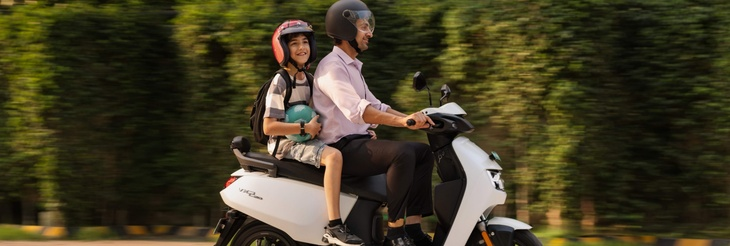
| Summary: Choosing a family electric scooter in India requires a careful look at safety, range, charging options, and daily usability. This guide covers every factor families should weigh before buying. |
According to recent data, EV adoption in India reached 8.26% across vehicle categories. A family electric scooter carries more than one rider. It carries school bags, weekly groceries, and the daily pressure of reaching the office on time. For households in cities like Bengaluru, Pune, or Hyderabad, the right scooter replaces multiple auto rides every week while keeping running costs low.
If you are comparing electric scooters for your family, the options can feel overwhelming. Range figures differ, battery types vary, and not every model handles a pillion passenger with equal stability. Here's what to look for when choosing a family electric scooter.
What Is a Family Electric Scooter? (Definitions & Key Features)
A family electric scooter is a battery-powered two-wheeler designed to carry two people comfortably across daily urban distances, with enough storage for helmets, lunch bags, or a small grocery load. It prioritises ride stability, pillion comfort, braking reliability, and sufficient range to cover school runs, office commutes, and errands on a single charge.
Key checks while choosing a family electric scooter include:
Comfort for two: Check seat space, foot placement, suspension behaviour, and low-speed balance.
Useful range: Cover your busiest normal day with a sensible buffer.
Practical storage: Look for enough room for everyday bags, helmets, or shopping.
Convenient charging: Match the charging method to your parking setup.
Service access: Confirm authorised support near home or work.
Why Indian Families Are Switching to Electric Scooters in 2026
The shift is driven by daily economics and urban convenience. Running costs for electric scooters sit at a fraction of what a conventional commute costs per kilometre, and home charging from a standard 5A socket removes fuel-station detours.
Indian cities have also seen a visible expansion of public fast-charging networks, reducing the concern about mid-trip range limits. A lower maintenance load (no engine oil or clutch cable replacements) further tips the ownership arithmetic in favour of electric for urban households.
Top Features to Look for in a Family Electric Scooter
A family electric scooter should score well on safety, range, and everyday practicality. Here is where to focus your comparison.
Safety Features That Matter Most
Safety is non-negotiable when choosing an electric scooter. These five features should be at the top of your comparison checklist:
Combined braking system (CBS): Distributes braking force across both wheels, reducing the risk of a skid during sudden stops.
Front disc brake with rear drum: Delivers stronger, more controlled stopping power than a drum-only setup.
All-LED projector headlamps: Improve visibility during early-morning school runs and late-evening commutes.
IP67/IP68 ingress protection: Seals the battery and motor against water and dust, keeping the scooter reliable through monsoons and dusty summers.
Crash and fall alerts: Notify a chosen contact through the connected app the moment an incident occurs.
Battery and Range Specifications Explained
Battery capacity, measured in kilowatt-hours (kWh), determines how far a scooter travels per charge. IDC-certified range gives you a lab-tested benchmark, but real-world range depends on riding speed, passenger weight, and road gradient.
For a family covering 30–50 km daily, a scooter offering 90 km or more of real-world range is a practical baseline. Removable batteries add flexibility, like the ability to carry the battery inside and charge at any 5A household socket if your parking area lacks a power outlet.
Best Family Electric Scooter Models in India (2026)
VIDA, powered by Hero MotoCorp, offers two product series built around daily urban riding realities, backed by four decades of two-wheeler engineering and 125 million-plus customers.
VIDA V2: The Complete Family Electric Scooter
The V2 series is VIDA's performance flagship. The VIDA V2 Pro delivers 165 km IDC range from dual removable batteries (2 x 1.97 kWh), a 6 kW motor producing 25 Nm torque, and a top speed of 90 km/h. Four ride modes (Eco, Ride, Sport, and the V2 Pro-exclusive Custom Mode), a 7-inch TFT touchscreen, turn-by-turn navigation, and cruise control (30–60 km/h) complete the package.
VIDA VX2: Built for Growing Families
The VX2 series brings VIDA's smart features into a lighter, city-focused frame. The VX2 Plus is available in two battery configurations: the 4.4 kWh variant delivers 187 km IDC range and a top speed of 90 km/h, while the 3.4 kWh variant offers 146 km at 80 km/h. Both feature Sport mode and a 4.3-inch TFT display. The VIDA VX2 Go suits shorter commutes: 93 km range in the 2.2 kWh variant, and 146 km in the 3.4 kWh variant.
| Feature | V2 Pro | V2 Plus | VX2 Plus 4.4 kWh | VX2 Plus 3.4 kWh | VX2 Go 3.4 kWh | VX2 Go 2.2 kWh |
| IDC Range | 165 km | 143 km | 187 km | 146 km | 146 km | 93 km |
| Top Speed | 90 km/h | 85 km/h | 90 km/h | 80 km/h | 70 km/h | 70 km/h |
| Battery | 2 × 1.97 kWh | 2 × 1.72 kWh | 4.4 kWh | 3.4 kWh | 3.4 kWh | 2.2 kWh |
| Front Brake | Disc (CBS) | Disc (CBS) | Disc (CBS) | Disc (CBS) | Drum (CBS) | Drum (CBS) |
| Under-seat Storage | 26 L | 26 L | 27.2 L | 27.2 L | 27.2 L | 33.2 L |
| Vehicle Warranty | 5 yr / 50,000 km | 5 yr / 50,000 km | 5 yr / 50,000 km | 5 yr / 50,000 km | 5 yr / 50,000 km | 5 yr / 50,000 km |
Family Electric Scooter Price Range in India
Electric scooter pricing in India varies by battery capacity, motor output, and feature set. Evaluate total cost rather than sticker prices alone: running cost per kilometre, warranty coverage, and battery protection options. VIDA's running cost sits at ₹0.17/km across models.
| Did You Know? All VIDA EVooters share the same charging socket for both the vehicle and the detached battery. No separate adaptor needed. Plug the scooter in at home, or remove the battery and charge at any standard 5A socket. The same socket design works at VIDA's 5,900+ fast-charging stations across 450+ Indian cities, where a full charge takes approximately 62 minutes. |
How to Choose the Right Family Electric Scooter for Your Household
Start with your household's busiest normal day. The scooter should cover that distance, fit your charging setup, carry your usual pillion and bags, and remain easy to handle.
Map daily distance: Include work, school runs, errands, and regular detours.
Add range margin: Allow for pillion load, traffic, gradients, and weather.
Check charging: Confirm access to a safe, properly earthed socket.
Test comfort: Assess seat space, braking feel, turning, and low-speed balance.
Review support: Compare warranty, service intervals, and authorised centres.
A manufacturer-backed service centre in your city reduces downtime and simplifies warranty claims.
Safety Features in VIDA Family Electric Scooters
Every VIDA model includes crash and fall alerts, geofence notifications, over-speed alerts, and remote immobilisation through the VIDA app. You can set speed limits for family members and receive instant alerts if the scooter moves outside a defined zone.
The VIDA V2 Plus pairs a front disc brake with a rear drum under CBS, IP68 motor protection (IP67 for the battery), and audio cues that alert pedestrians in crowded lanes.
Charging Your Family Electric Scooter: Complete Guide for Indian Homes
VIDA offers three charging methods.
Direct vehicle charging: You can plug a cable into the scooter at your parking spot.
Removable battery charging: You can detach the battery, carry it inside, and charge at any standard 5A socket, ideal for families in apartments without dedicated parking outlets.
VIDA's fast-charging network: You can charge your electric scooter in 5,600-plus stations across 415 cities, delivering a full charge in approximately 62 minutes.
Real-World Range and Performance for Indian Families
IDC-certified range figures provide a useful benchmark, but actual daily range depends on rider-plus-pillion weight, ride mode, road gradient, and tyre pressure.
Eco mode maximises range by limiting top speed. Sport mode (on V2 Pro, V2 Plus, and VX2 Plus) delivers quicker overtaking but draws more energy. The VX2 Plus returns approximately 100 km of real-world range, comfortable for a 40 km daily round trip.
Regenerative braking on all VIDA models recovers kinetic energy during deceleration, adding consistent range gains across city riding.
Registration, Insurance, and Documentation for Family Electric Scooters in India
Registering an electric scooter in India follows the same Motor Vehicles Act process as any two-wheeler: proof of address, identity, the manufacturer's invoice, and Form 20. Most VIDA dealerships handle this paperwork during the purchase itself. Third-party insurance is mandatory, and comprehensive cover (own-damage, theft, third-party liability) is recommended for a scooter in daily family use.
Maintenance and After-Sales Service for Family Electric Scooters
Electric scooters have fewer moving parts, which reduces the maintenance load considerably. There is no engine oil, spark plug, or clutch cable. Routine service covers brake pads, tyre condition, suspension, and battery health diagnostics.
VIDA backs every scooter with a 5-year / 50,000 km vehicle warranty and a 3-year/30,000 km battery warranty as standard. Families wanting extended battery coverage can opt for the VIDA Extended Battery Warranty plan (5 years / 60,000 km). A separate opt-in Comprehensive Warranty covers 11-plus critical components for up to 5 years/75,000 km.
Family Electric Scooter for School Runs and Daily Errands
A typical family day generally covers a 6 km school drop-off, a 12 km office commute, a grocery stop, and a short evening errand, totalling roughly 30–40 km. A scooter with 90 km or more of real-world range handles this without a midday charge. The 27.2-litre under-seat boot on VX2 models fits a child's school bag, and the VIDA VX2 Go 3.4 kWh offers 142 km IDC range, leaving ample reserve.
Monsoon Readiness: Using Your Family Electric Scooter in Indian Rainy Season
Riding through the monsoon is a daily reality in most Indian cities between June and September. VIDA addresses water ingress with IP68 motor protection and IP67 battery protection across all models.
All-LED projector headlamps improve visibility during monsoon rides, and CBS-equipped braking reduces the risk of wheel lock-up on wet surfaces. A pre-monsoon tyre tread check and brake pad inspection at an authorised VIDA Hub keeps the scooter reliable through weeks of wet roads. Test rides in your city let you feel the braking and stability first-hand before buying.
Conclusion
A family electric scooter that handles monsoons, school runs, and a full week of commuting is a practical addition to any urban Indian household.
The right electric scooter model comes down to matching your daily kilometres, your charging setup, and the safety features that matter for your family's specific routine.
FAQs
1. What is the average price of a family electric scooter in India?
Family-capable electric scooters in India span a wide range depending on battery capacity, motor output, and connected features. Entry-level models with single batteries start lower, while dual-battery scooters with TFT displays sit at a higher bracket. Check manufacturer websites for current pricing, as figures change with subsidies and seasonal offers.
2. What is the minimum range needed for a family electric scooter?
For a household covering 30–40 km daily (combining school runs, office commutes, and errands), a real-world range of at least 80–90 km per charge provides a comfortable buffer. This ensures you do not need to charge mid-day on most days.
3. Do I need a driving licence to ride a family electric scooter in India?
Yes. Electric scooters with a top speed above 25 km/h require a valid two-wheeler driving licence and registration under the Motor Vehicles Act. Most family-oriented electric scooters exceed this threshold, so a licence is mandatory.
4. What safety features should a family electric scooter have?
Prioritise combined braking systems (CBS), a front disc brake, all-LED projector lighting, and IP67 or higher ingress protection on the battery and motor. Connected features like crash alerts, geofence notifications, and over-speed alerts add practical value for families.
5. How much does it cost to charge a family electric scooter at home?
Home charging costs depend on your state electricity tariff and the scooter's battery capacity. As a benchmark, VIDA EVooters run at approximately ₹0.17 per kilometre, making a 40 km daily commute cost under ₹7 in electricity.
6. Can two adults ride comfortably on a family electric scooter?
Yes, provided the scooter's suspension, seat width, and footboard are designed for pillion riding. A ground clearance of 155 mm and a well-tuned suspension help maintain stability with two adults on board, especially over speed breakers.
7. How long does the battery last in a family electric scooter?
Battery longevity is measured in charge cycles and years. Most lithium-ion EV batteries maintain usable capacity for three to five years under normal daily use. VIDA offers a standard 3-year / 30,000 km battery warranty, extendable to 5 years/60,000 km through the opt-in Extended Battery Warranty plan.
8. Are electric scooters safe to ride during monsoons?
Electric scooters with IP67 or IP68-rated batteries and motors are engineered to handle sustained water exposure. Combined braking systems reduce the risk of skidding on wet roads. Check tyre tread depth and brake responsiveness before the monsoon season.
9. What is the charging time for a family electric scooter?
Charging times vary by battery capacity. A 2.2 kWh battery can reach 80% in roughly 2 hours 41 minutes at home, while a larger 3.94 kWh dual-battery setup takes approximately 5 hours 55 minutes. Fast-charging stations bring a full charge in about 62 minutes, depending on the model.
10. How much maintenance does a family electric scooter need?
Electric scooters require less maintenance than conventional two-wheelers because they have no engine oil, spark plugs, or clutch cables. Routine servicing involves brake pad checks, tyre inspections, suspension evaluation, and battery health diagnostics. Service intervals are generally longer, reducing both visits and costs.