LFP vs NMC: Understanding Battery Chemistry in Indian Electric Scooters
Published by VIDA
Read Time: 1 min 30 sec
Date: 04 November 26
| Summary: LFP and NMC are the two dominant battery chemistries in Indian electric scooters. Here is how they compare on safety, range, lifespan and cost, and what each means for your daily ride. |
India's electric vehicle sales crossed 26.6 lakh units in FY2026, pushing overall EV penetration to 8.62% of total automotive registrations. Two-wheelers and three-wheelers make up nearly 87% of that volume. That growth brings a new kind of buying question. Spec sheets now list terms like LFP and NMC alongside range and top speed, and most buyers have no clear framework for judging what these labels mean in practice.
Battery cell chemistry determines how safe a pack remains in peak Indian summer heat, how many years of commuting it can deliver before capacity drops noticeably, and how much range you get per kilogram of battery weight. Two chemistries dominate the Indian electric scooter space: LFP (lithium iron phosphate) and NMC (nickel manganese cobalt). Both are lithium-ion variants, but they prioritise different performance characteristics.
Here's what separates the two, how each performs in Indian conditions, and what to look for when you read a scooter's battery spec.
LFP vs NMC in One Line
LFP (lithium iron phosphate) prioritises thermal stability and long cycle life, making it a strong fit for hot climates and daily charge routines. NMC (nickel manganese cobalt) prioritises higher energy density, which translates to more range from a lighter, more compact pack. That single trade-off, safety and longevity versus energy per kilogram, shapes every other difference between these two lithium-ion chemistries.
If you are weighing two electric scooters and one uses LFP while the other uses NMC, the decision is really about what you value more for your riding pattern and ownership horizon. Neither chemistry is universally better. Each fits different priorities.
| Did You Know? LFP batteries accounted for over 55% of all EV batteries deployed globally in 2025, according to the IEA's Global EV Outlook 2026. LFP's cost advantage and thermal safety profile have driven the shift, with adoption accelerating fastest in markets with hot climates and cost-sensitive buyers. |
What Is LFP Battery Chemistry?
LFP stands for lithium iron phosphate (chemical formula: LiFePO₄). It uses iron and phosphate as the cathode material instead of nickel or cobalt. The result is a cell that is inherently more thermally stable, with a thermal runaway threshold near 270°C, significantly higher than NMC's. For a scooter parked outdoors in Chennai's 42°C summer or under direct sunlight in Delhi, that margin matters.
LFP's cycle life is its other standout trait. These cells typically sustain 2,000 or more full charge-discharge cycles before capacity drops below 80%, with well-engineered configurations pushing well beyond that range. Long cycle life means less capacity degradation over years of daily battery health management and top-up charging.
The trade-off is energy density. LFP cells store roughly 90–160 Wh/kg, which is lower than NMC. A lithium iron phosphate scooter battery with the same capacity as an NMC pack will be heavier, or a same-weight LFP pack will store less energy. LFP also performs less efficiently in very cold conditions (below 0°C), though this is rarely relevant for most Indian cities.
What Is NMC Battery Chemistry?
NMC stands for nickel manganese cobalt. The cathode blends these three metals in varying ratios (common configurations include NMC 532, 622, and 811), and the specific ratio determines the balance between energy density, stability, and cost. Higher nickel content means more energy per kilogram; higher manganese and cobalt content means better structural stability and cycle life.
An NMC battery electric scooter benefits from energy density in the range of 150–250 Wh/kg, depending on the cell configuration. That means a lighter or more compact pack for the same stored energy, which directly benefits scooter weight and, by extension, handling and range.
The trade-off is thermal management. NMC cells have a lower thermal runaway threshold (around 150°C for high-nickel variants, up to roughly 210°C for lower-nickel formulations) compared to LFP, which means the battery management system (BMS) has to work harder to keep temperatures in check during fast charging or sustained high-speed riding. NMC cycle life is also shorter, typically ranging between 1,000–2,000 full cycles before reaching 80% capacity retention.
LFP vs NMC: Side-by-Side Comparison
LFP leads on thermal safety and cycle life, while NMC leads on energy density and cold-weather performance. For Indian electric scooter buyers, the practical differences show up in pack longevity, weight, and heat handling. The table below maps the core differences across the parameters that matter most for daily ownership.
| Parameter | LFP | NMC |
|---|---|---|
| Safety / thermal stability | Higher (runaway threshold ~270°C) | Good, needs active management (~150°C for high-nickel variants) |
| Cycle life (to 80% capacity) | 2,000+ cycles (higher in optimised configs) | 1,000–2,000 cycles |
| Energy density | 90–160 Wh/kg | 150–250 Wh/kg |
| Weight for same capacity | Heavier | Lighter |
| Cold-weather performance (below 0°C) | Weaker | Better |
| Raw material cost | Typically lower (no cobalt, no nickel) | Typically higher (cobalt and nickel dependent) |
| Cobalt dependency | None | Yes (varies by NMC ratio) |
Thermal runaway thresholds and energy density ranges are indicative and vary by cell manufacturer and configuration. Cycle life depends on charging habits, ambient temperature, and depth of discharge.
Both chemistries perform well when paired with a well-designed BMS that monitors cell temperatures, balances charge distribution, and prevents overcharging. The chemistry sets the baseline; the BMS and pack design determine real-world reliability.
Which Chemistry Suits Indian Conditions?
For most Indian electric scooter riders, daily commute distances range between 20 and 50 km, ambient temperatures regularly exceed 35°C for five to six months a year, and scooters spend hours parked in direct sunlight or inside warm garages. These conditions create specific priorities for battery safety.
Thermal stability ranks high in this context. A chemistry that handles sustained heat without aggressive cooling intervention reduces long-term risk. LFP's higher thermal threshold gives it a natural advantage in Indian summers, where surface temperatures on a parked scooter's body can climb well above the air temperature.
Cycle life matters equally. Indian two-wheeler riders tend to charge frequently (often daily) and use top-up charging patterns rather than full 0–100% cycles. LFP handles this pattern well, retaining capacity over a longer ownership period. NMC, while delivering more range per charge, may degrade faster under the same daily top-up routine in hot conditions.
Energy density favours NMC for riders who need maximum range from a compact, lightweight pack. If your daily commute exceeds 60 km or you ride at highway-adjacent speeds regularly, the extra energy per kilogram is a genuine advantage.
The practical answer is that both chemistries work well in India when the manufacturer pairs them with proper thermal management, a capable BMS, and a warranty structure that backs the pack's expected life. The chemistry label alone does not determine battery quality.
What VIDA Uses and Why
VIDA, powered by Hero MotoCorp, specifies lithium-ion removable batteries across its current lineup, from the VIDA V2 Pro (3.94 kWh) to the VX2 Go 2.2 kWh. Every pack carries an IP67 ingress protection rating for the battery and IP68 for the motor, which means resistance to dust and temporary submersion, a practical requirement for monsoon-season riding across Indian cities.
VIDA's approach to battery confidence goes beyond cell chemistry. The standard battery warranty covers 3 years or 30,000 km, and riders can opt for an extended battery warranty plan to extend that to 5 years or 60,000 km. This plan covers both failure and performance degradation (triggered when state of health drops below 70%), and it transfers to a new owner at any authorised service centre.
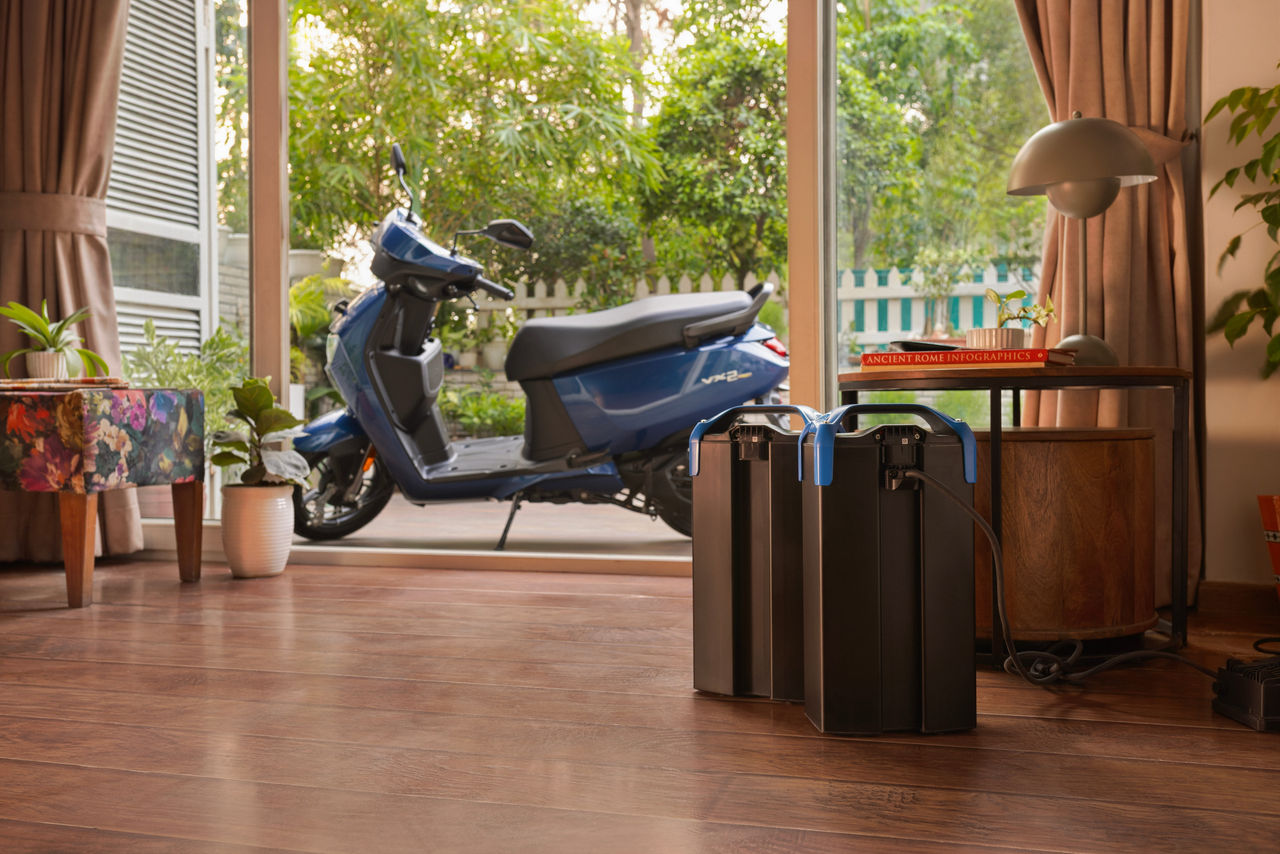
The removable battery design across all current VIDA models adds a layer of chemistry-agnostic charging flexibility. You can charge the pack inside your apartment at any standard 5A socket, plug directly into the scooter, or use one of the 5,900+ fast-charging stations across 450+ cities. The same socket works for both the vehicle and the detached battery, with no adaptor required.
Every VIDA battery pack integrates with the scooter's connected features, including real-time battery monitoring, charge-level alerts, and OTA updates to the battery management system.
Conclusion
Battery chemistry is one piece of the ownership equation, not the whole answer. LFP and NMC each bring measurable strengths to different riding profiles, and Indian conditions, with sustained heat and daily charge cycles, make thermal stability and long cycle life particularly relevant.
Real-world battery performance over five years of daily commuting depends on the full package: cell quality, BMS design, thermal management, charging flexibility, and the warranty backing it all. Knowing the difference between LFP and NMC helps you ask better questions at the showroom. The answers you get about warranty depth, pack protection, and charging convenience will tell you the rest.
FAQs
1. What is the difference between LFP and NMC batteries?
LFP (lithium iron phosphate) and NMC (nickel manganese cobalt) are both lithium-ion chemistries, but they use different cathode materials. LFP offers higher thermal stability and longer cycle life, while NMC provides higher energy density, which means more range from a lighter battery pack. The choice between them depends on whether you prioritise safety and longevity or maximum range per kilogram.
2. Which battery chemistry is safer for electric scooters?
LFP has a higher thermal runaway threshold (approximately 270°C compared to NMC's 210°C), making it inherently more resistant to overheating. This margin matters in India's hot climate, where scooters are often parked in direct sunlight. That said, both chemistries perform safely when paired with a well-designed battery management system.
3. Which chemistry gives more range?
NMC provides more range per kilogram of battery weight because of its higher energy density (150–250 Wh/kg versus LFP's 90–160 Wh/kg). If two scooters carry the same battery weight, the NMC-equipped scooter will generally offer a longer IDC range. However, real-world range depends on riding speed, terrain, rider weight, and ambient temperature, not just chemistry.
4. Which battery lasts longer, LFP or NMC?
LFP batteries typically deliver 2,000 or more full charge-discharge cycles before dropping to 80% of original capacity, and well-engineered cells can last much longer. NMC batteries generally achieve 1,000 to 2,000 cycles under similar conditions. For daily Indian commuters who charge frequently in hot conditions, LFP's cycle life advantage can translate to several extra years of strong battery performance.
5. What battery chemistry does VIDA use?
VIDA specifies lithium-ion removable batteries with IP67 protection across all current models. The standard battery warranty is 3 years or 30,000 km, extendable to 5 years or 60,000 km through VIDA Battery+. VIDA's ownership structure pairs the battery with real-time monitoring, OTA-updatable battery management, three charging methods, and a 5,900+ station fast-charging network.
6.Does battery chemistry affect charging speed?
Both LFP and NMC cells can accept fast charging, but the rate depends on pack design, BMS configuration, and charger compatibility rather than chemistry alone. LFP cells are generally more tolerant of frequent 100% charging without accelerated degradation, while NMC cells benefit from being kept between 20% and 80% for longest lifespan.
7. Is LFP better than NMC for Indian weather?
India's sustained high temperatures (35–45°C across many months) favour chemistries with higher thermal stability. LFP's wider thermal safety margin reduces heat-related degradation risk for scooters parked outdoors or ridden in stop-and-go city traffic. NMC performs well too, provided the scooter's thermal management and BMS are designed for Indian conditions.