Graphene Battery vs Lithium-ion: Which Technology Wins for Electric Scooters?
Published by VIDA
Read Time: 1 min 30 sec
Date: 06 November 26
| Summary: The term graphene battery appears frequently in EV marketing, but it rarely means what buyers assume. Here's how graphene-enhanced cells compare with mainstream lithium-ion, and which technology actually delivers for electric scooter riders today. |
India added over 10 lakh electric two-wheelers to its roads through government purchase incentives alone. The battery pack inside each of these scooters determines range, charging speed, and a significant share of the sticker price, making the chemistry inside the pack one of the first things a serious buyer should understand.
One term that surfaces regularly on spec sheets and advertisements is graphene battery. For buyers comparing models, the concern is natural: whether graphene represents a better technology and whether choosing lithium-ion means settling for less
Here's how these two labels compare, what graphene actually does inside a cell, and which factors should guide your purchase.
The Straight Answer
In most commercial contexts, a graphene battery is a lithium-ion cell that uses graphene as a conductive additive in its electrodes. It's not a separate battery chemistry. For electric scooters available in India today, proven lithium-ion remains the mainstream, reliable, and widely serviced choice.
Marketing positions graphene batteries as a distinct category, but graphene enhances certain properties of lithium-ion cells (conductivity, heat dissipation, charge speed) rather than replacing the underlying electrochemistry. The cathode-anode structure, electrolyte, and charge-discharge cycle stay the same.
What Graphene Battery Actually Means
Graphene is a single layer of carbon atoms arranged in a honeycomb lattice that conducts electricity better than almost any other material at room temperature. Adding graphene to a lithium-ion cell's electrodes increases the surface area for ion transfer and improves electron flow through the pack.
Simulation-based research found that graphene-enhanced cells can reduce charging times by 22% to 27% compared to conventional lithium-ion packs while maintaining lower operating temperatures. These findings come from modelled environments, not from mass-produced scooter packs.
The term is also used loosely, with graphene-enhanced lead-acid batteries marketed under the same label in some markets. If a spec sheet lists graphene battery under its chemistry, knowing the standard EV terminology makes it easier to ask whether the pack is graphene-enhanced lithium-ion or something else entirely.
| Did you know? Graphene's theoretical surface area reaches 2,630 m² per gram, far exceeding the graphite used in conventional lithium-ion anodes. That surface area drives the improved conductivity and faster ion transfer in graphene-enhanced cells. Translating lab-grade graphene into affordable, mass-produced scooter packs remains an engineering challenge no manufacturer has fully solved. |
How Lithium-ion Powers Electric Scooters Today
Lithium-ion is the established battery chemistry for electric two-wheelers in India, chosen for its proven energy density, predictable cycle life, and compatibility with the country's service and charging networks. Every VIDA model uses Li-ion removable packs, from the VIDA VX2 Plus at 3.4 kWh to the V2 series at up to 3.94 kWh.
Three properties make lithium-ion the default for scooters in this market.
- Energy density at a practical weight: A 3.4 kWh pack delivers up to 146 km IDC range without pushing kerb weight past 115–120 kg.
- Established safety frameworks: BMS, IP67 ingress protection, and thermal monitoring are mature technologies that every reputed Indian manufacturer deploys.
- Scale and serviceability: Lithium-ion cells are produced at volumes that keep costs predictable, and battery health diagnostics, dealer networks, and warranty structures are all optimised for this chemistry.
Together, these factors explain why lithium-ion dominates India's EV two-wheeler segment.
Graphene vs Lithium-ion: Side-by-Side
Here's how both technologies compare on the parameters that matter for scooter buyers in India.
| Parameter | Graphene-enhanced | Lithium-ion (mainstream) |
|---|---|---|
| Maturity for e-scooters | Emerging, limited commercial availability | Proven, widely deployed across Indian OEMs |
| Energy density/range | Lab claims vary; real-world scooter data is sparse | Established and verified by IDC standards |
| Charging speed | Faster in lab settings; unproven at fleet scale | Improving steadily; fast-charging networks expanding |
| Thermal management | Improved conductivity at the additive level | Managed by proven BMS and IP67-rated enclosures |
| Ecosystem and service | Limited dealer and diagnostic support | Broad service networks, standardised warranty terms |
| Cost | Higher manufacturing cost; premium pricing | More affordable at scale; clear warranty structures |
Lithium-ion's advantage today goes beyond the technical. The entire ownership experience, from charging stations to warranty claims, is built around it.
What This Means for Your Purchase Decision
When evaluating a graphene battery scooter against a lithium-ion scooter, the chemistry label matters less than the warranty backing it, the service network supporting it, and the real-world range it delivers. A battery that performs well in a lab but lacks dealer-level diagnostics or clear warranty terms is a risk, not an upgrade.
Ask these three questions before any purchase.
- Battery warranty terms: Check how many years and kilometres the manufacturer covers, and whether an extended option exists.
- Charging ecosystem: Confirm you can charge at home, at work, and on the road without workarounds.
- Service support: Verify that a local service centre can diagnose or replace the pack.
If any of these answers are vague, the battery's chemistry label becomes secondary. You can compare specifications across models and prioritise the scooter that offers the clearest answers on all three.Every VIDA EV scooter qualifies for the PM E-DRIVE subsidy, charges via any standard 5A home socket or the 5,900+ fast-charging station network, and comes with a standard 5-year/50,000 km vehicle warranty. Running cost across all models sits at approximately ₹0.17/km.
VIDA's Approach to Battery Technology
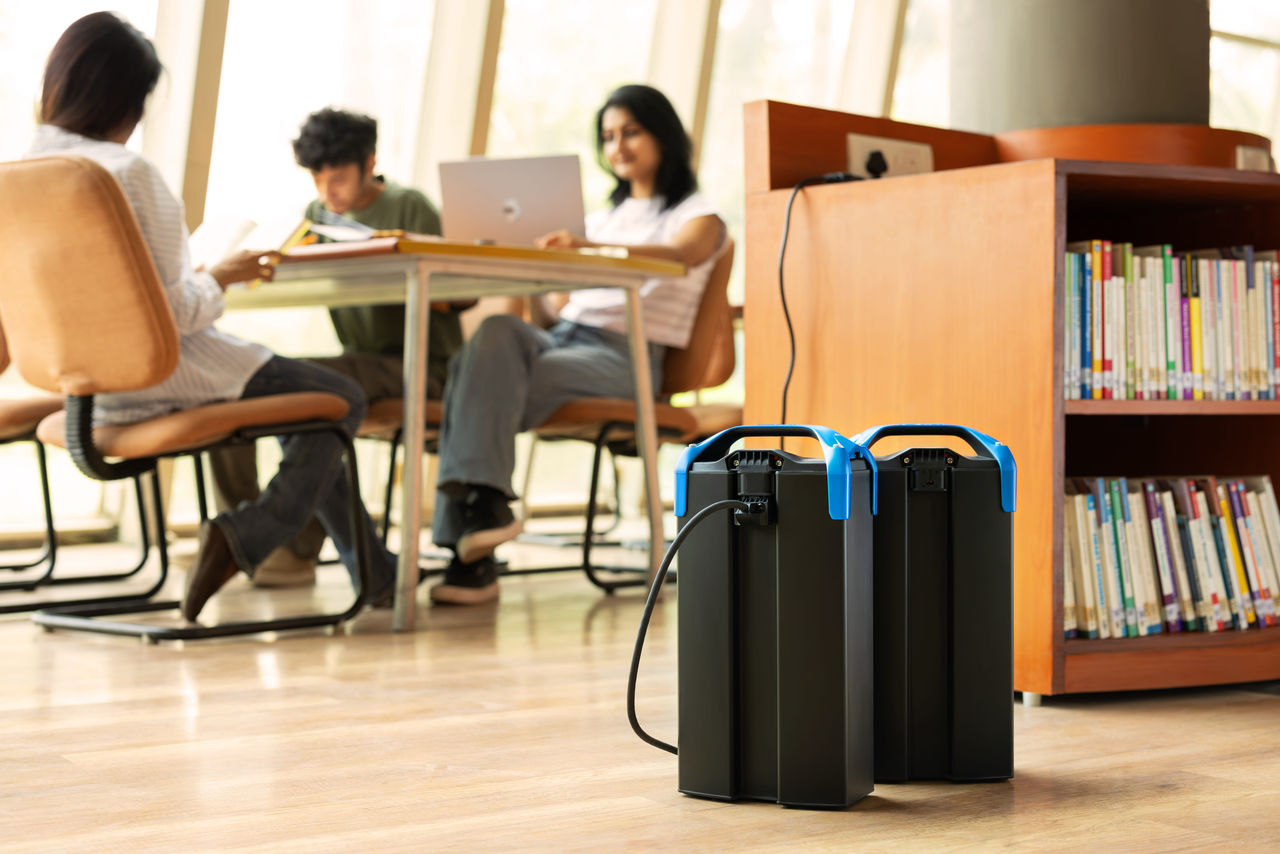
VIDA, powered by Hero MotoCorp, uses lithium-ion battery packs across its lineup, pairing proven cell chemistry with smart battery management, IP67 ingress protection, and a removable battery design that lets riders carry the pack indoors and charge at any 5A home socket.
Every VIDA scooter comes with a standard 3-year/30,000 km battery warranty, extendable to 5 years/60,000 km through the VIDA Extended Battery Warranty plan. This extended warranty plan also covers performance degradation, triggering replacement when State of Health drops below 70%.
Proven chemistry, transparent warranty terms, and 700+ service outlets are what separate a well-engineered battery system from a marketing label.
Conclusion
Graphene is a genuinely promising material, and real science backs its role in battery enhancement. But promising and proven are different milestones. For an Indian buyer choosing a scooter today, lithium-ion offers verified range, established service infrastructure, transparent warranty coverage, and a charging ecosystem that covers home, office, and highway.
The more useful framing skips the graphene vs lithium-ion debate entirely. It focuses on whether the battery in your scooter is backed by the warranty, the engineering, and the service network that make ownership practical for years to come.
FAQs
1. Is a graphene battery better than lithium-ion?
Graphene enhances lithium-ion cells by improving conductivity and heat dissipation, but it's an additive, not a replacement. For electric scooters available in India today, mainstream lithium-ion packs offer proven range, established service networks, and clear warranty terms that graphene-enhanced cells have not matched at commercial scale.
2. Is graphene a separate battery chemistry?
No. Graphene is a carbon-based material used as an additive within existing chemistries, most commonly lithium-ion. A graphene battery is typically a lithium-ion cell with graphene incorporated into the electrodes to improve conductivity and heat management.
3. Do graphene batteries charge faster?
In laboratory settings, graphene-enhanced cells have demonstrated faster charge times due to improved electron conductivity and greater ion-transfer surface area. These results have not yet been replicated in mass-produced scooter packs. Mainstream lithium-ion is also improving, with fast-charging stations now offering full charges in approximately 62 minutes.
4. Which battery technology is more reliable for scooters?
Lithium-ion is the more reliable choice today, backed by years of field data, mature battery management systems, and standardised warranty frameworks. Graphene-enhanced cells show promise but lack the commercial track record and service support that lithium-ion offers in India..
5. What battery does VIDA use?
VIDA uses lithium-ion removable battery packs across its lineup. Each pack is IP67-rated, monitored by a smart BMS, and covered by a standard 3-year / 30,000 km battery warranty extendable to 5 years / 60,000 km through the VIDA Extended Battery Warranty plan.