Which Battery is Best for Your Electric Scooter? A Buyer's Guide
Published by VIDA
Read Time: 1 min 30 sec
Date: 04 November 26
| Summary |
| This electric scooter battery buying guide helps Indian riders pick the right chemistry, capacity, and safety features. Learn what matters most and how VIDA EV scooters fit different commute needs. |
The battery is an electric scooter’s most important component. It affects range, performance, and resale value. So, which battery is best for riders in India? Your choice depends on how far you ride each day, how you charge, and the warranty you need.
Electric two-wheelers made up 57.8% of India’s EV sales in FY2026. With more battery options available, choosing the right one can be confusing.
This guide explains what matters most when buying an electric scooter battery.
The 5 things that decide a good scooter battery
1. Chemistry and safety
Lithium-ion batteries are now standard. Focus on safety certifications, not chemistry alone.
- Check for AIS-156 compliance and BIS certification.
- A certified BMS should protect against thermal events and other battery risks.
2. Usable capacity for your commute
Battery capacity is measured in kWh. Choose a size that matches your daily distance.
- 2.2 kWh: Around 75–93 km real-world range
- 4.4 kWh: Over 140 km real-world range
A larger pack costs more and adds weight, so choose only what you need.
3. Charging convenience
Your charging setup matters as much as range. Look for:
- Removable batteries for easier home charging
- Direct vehicle charging
- Portable charging at home
- Access to fast-charging networks
India had 29,151 public EV charging stations by December 2025. However, home charging remains the most practical option for daily use.
4. Battery management and monitoring
A good Battery Management System (BMS) protects against overcharging, deep discharge, and overheating. Smart features can also show battery health, charge status, and alerts through an app.
5. Warranty and after-sales support
- Battery replacement can be expensive. Look for:
- Extended warranty options
- Service centres near you
A strong warranty and reliable service network can make ownership easier.
| Pro Tips |
| When evaluating the best battery for your electric scooter, skip the spec sheet arms race. Instead, note your actual commute distance for a week, then pick a battery with at least 1.5 times that range in real-world (not IDC-certified) terms. This buffer covers weather, traffic, passenger weight, and the occasional detour. Also ask about the warranty's state-of-health threshold; a guarantee that covers degradation below 70% SoH is more valuable than one that only covers outright failure. |
Match the battery to your riding needs
Your ideal battery depends on how far you ride daily and how you charge. Here is a practical breakdown:
| Rider profile | What to prioritise | Suggested VIDA fit |
|---|---|---|
| Short city commute (20 to 30 km/day) | Convenience, lower upfront cost, easy home charging | VIDA VX2 Go (2.2 kWh, 93 km IDC range*, ~75 km real-world in Eco) |
| Mixed daily use (30 to 50 km/day) | Balanced range, Sports mode, good value | VIDA VX2 Plus (3.4 kWh, 146 km IDC*) or VIDA V2 Plus (3.44 kWh, 143 km IDC*) |
| Longer daily distance (50+ km/day) | Maximum range, cruise control, custom riding modes | VIDA V2 Pro (3.94 kWh, 165 km IDC*) or VIDA VX2 Plus 4.4 kWh (187 km IDC*) |
* IDC certified range per AIS040. Actual range varies based on road, vehicle, environment, payload, and riding style.
Under the PM E-DRIVE scheme, electric two-wheelers get ₹2,500 per kWh, capped at ₹5,000 per vehicle. So, battery size can affect your subsidy benefit.
For lower upfront costs, VIDA BaaS lets VX2 buyers pay for the chassis separately, from around ₹44,990, plus ₹1.24/km for battery usage. It includes fast-charging access and an extended warranty.
Why warranty and safety matter most
A MoRTH committee investigating electric two-wheeler fire incidents exposed gaps in battery management and cell safety, leading to tighter AIS-156 requirements.
As a buyer, check these three things:
- AIS-156 compliance:Covers thermal safety, BMS temperature sensors and audio-visual warnings.
- IP67 rating or higher: Protects the battery from dust and temporary water immersion, useful during monsoons.
- Battery warranty: Look beyond failure coverage. Plans that cover battery degradation offer stronger protection.
VIDA offers a standard 3-year/30,000 km battery warranty. The optional VIDA Extended Battery Warranty plan extends this to 5 years/60,000 km and covers degradation below 70% state of health. The plan is also transferable to a new owner.
How VIDA batteries are built for Indian riders
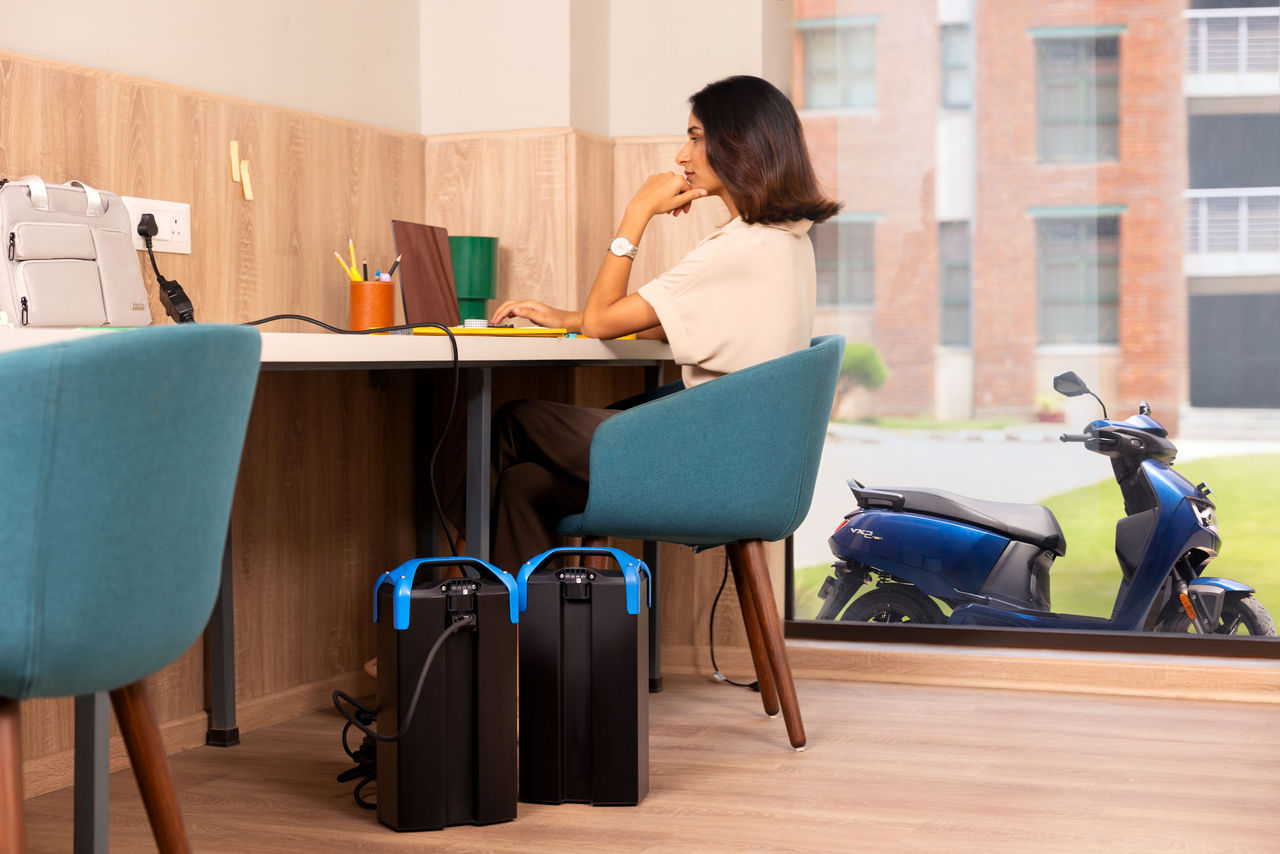
Every VIDA EV scooter uses removable Li-ion batteries with IP67 ingress protection. A shared charging socket works for both the vehicle and the detached battery, so you do not need a separate adaptor.
Three charging methods are available across all models:
- Home charging: Remove the battery, carry it to any standard 5A socket.
- Direct vehicle charge: Plug in the scooter directly where parking allows.
- Fast charging: 5,900+ VIDA fast-charging stations across India; 0 to 80% in approximately 65 minutes.
The VIDA Edge app lets riders monitor battery health, receive crash and fall alerts, set geo-fences and get OTA updates. V2 models feature a colour-coded 7-inch TFT touchscreen.For lower upfront costs, VX2 buyers can choose BaaS from around ₹44,990, plus ₹1.24/km. This includes fast-charging access and an extended warranty. VIDA scooters cost around ₹0.17/km to run.
Conclusion
Choosing the best electric scooter battery depends on your daily commute, charging needs, budget, and expected battery life. Look beyond capacity and range to factors such as battery chemistry, safety certifications, BMS features, warranty coverage, and after-sales support. Whether you need a compact battery for city rides or a larger pack for longer commutes, choosing the right capacity can make your EV ownership more practical and cost-effective.
FAQs
1. Which battery is best for an electric scooter in India?
A lithium-ion battery with AIS-156 certification, a reliable BMS, IP67 protection, and suitable capacity is ideal for Indian riders.
2. Is a bigger battery always better?
Not always. The average Indian city commute is 27–33 km, so choose capacity based on daily distance, not size alone.
3. What battery warranty should I look for?
Look for at least three years of coverage and check whether it includes degradation. VIDA offers 3 years / 30,000 km, with Battery+ extending coverage.
4. Are removable batteries better?
Yes, for many urban riders. Removable batteries support charging through a standard 5A socket, making them practical for apartments. VIDA EVooters offer this flexibility.
5. Which VIDA model suits my commute?
For under 30 km, choose VIDA VX2 Go; for 30–50 km, VX2 Plus or V2 Plus; for longer rides, V2 Pro.
6. What does AIS-156 certification mean for my battery?
AIS-156 sets battery safety requirements, including BMS, thermal testing, temperature sensors, and IP67 protection for electric two-wheelers.
7. How does BaaS work for electric scooters?
BaaS separates battery costs from the scooter. VIDA VX2 models offer lower upfront costs while you pay based on battery usage.